Cafe Loco Coffee Roasters in Panajachel has built an impressive reputation for specialty coffee with exceptional Guatemalan beans roasted on site. Customers consistently praise the balanced lattes, chai drinks, and knowledgeable baristas, making it a top choice for quality coffee at excellent prices in the region.
Panajachel: Lake Atitlan's Gateway and Transport Hub
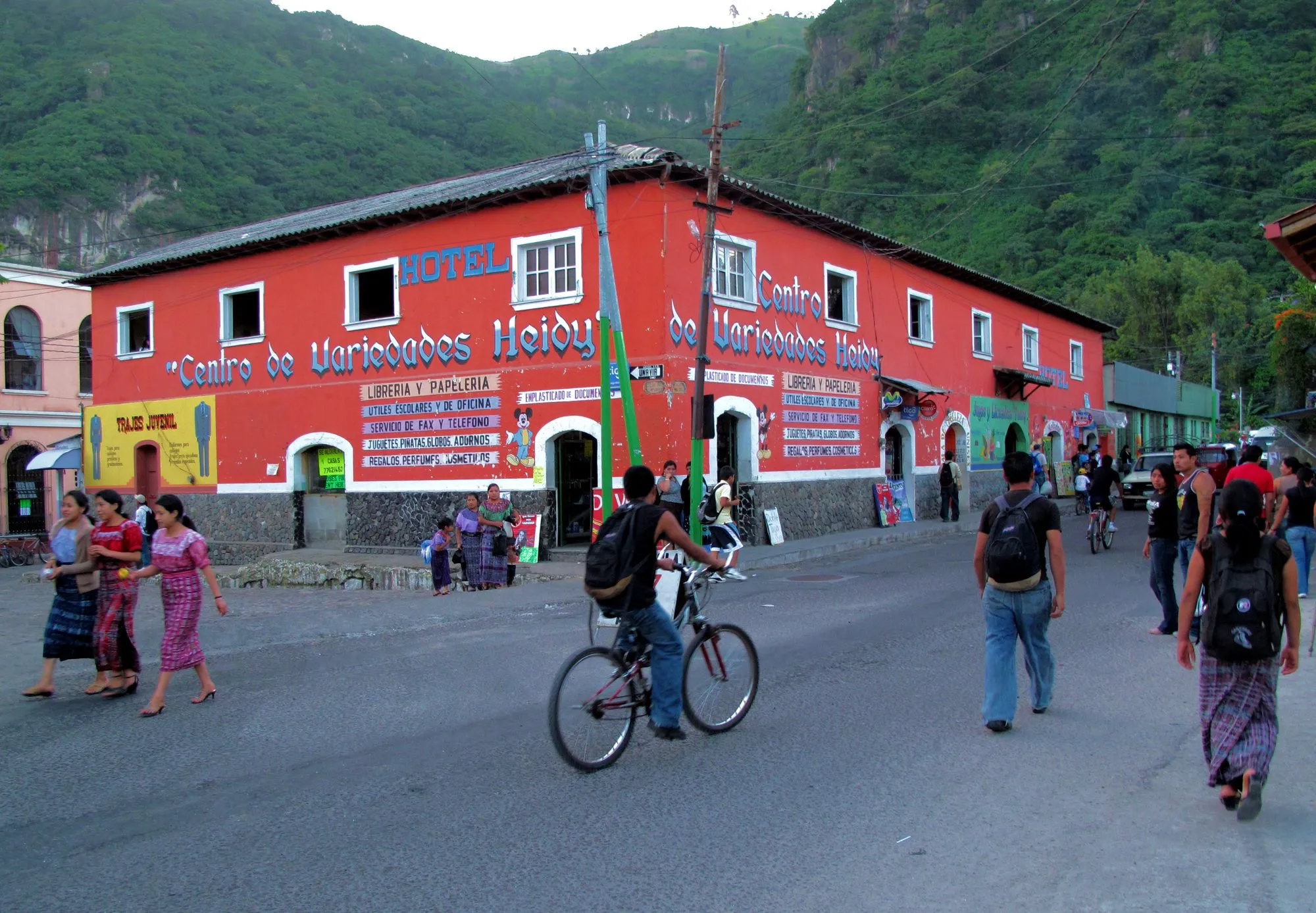
Photos via Google
Is Panajachel worth visiting? Yes as the lake's transport hub: shuttles, ATMs, Calle Santander shopping, and every lancha route to the other villages.
Yes, Panajachel is worth visiting as the main gateway to Lake Atitlán: it is the most developed town on the shoreline, with the widest range of hotels, the most reliable ATMs, Calle Santander's market strip, and the lancha docks that connect to every other village on the lake, though it is the busiest and least quiet town on the water.
Panajachel, known locally as "Pana," is the main gateway and transport hub of Lake Atitlán, sitting at about 1,597 meters on the northeast shore. It is the lake's most developed town, home to Calle Santander's market strip, the most reliable ATMs on the lake, and the public lancha docks connecting to every other lakeside village.
Use all 14 Lake Atitlan towns compared to choose a base. Pair this guide with Santa Catarina Palopó and Sololá, its most useful connections around the lake. Compare the decision in Panajachel vs San Pedro.
Is Panajachel worth visiting?
Yes, if you want a convenient base with real infrastructure or you are arriving at the lake for the first time. The tradeoff is calm. Pana is the busiest, most commercial town on the water, full of tuk tuks, vendors, and traffic, and it is not trying to be a retreat. Stay here if you want easy access to supermarkets, pharmacies, fast internet, banks, and a wide range of restaurants, if you travel with family or heavy luggage, or if you plan to use the lake as a base for day trips. One traveler who visited recently described Pana as feeling more "Guatemalan-forward" than the smaller villages: families on outings, couples, kids with snacks, domestic tourists dressed for a day out rather than a wellness reset.
Skip it, or just pass through, if you want a quiet retreat, a yoga-and-cacao reset, deep immersion in Maya village life, or the slow pace found across the lake. San Marcos La Laguna (wellness), Santa Cruz and Jaibalito (real quiet), San Juan La Laguna (cooperative craft culture), and Santiago Atitlán (Tz'utujil depth and history) are all thirty minutes away by lancha and deliver exactly that. For many travelers Pana is better as a day trip or launch pad than a final destination.
What are the best things to do in Panajachel?
The best things to do in Panajachel are walking Calle Santander, visiting the municipal market, spending 2 to 3 hours at Reserva Natural Atitlán, kayaking before noon, watching sunset from the malecón, and using Pana as the easiest base for Sololá, Chichicastenango, and lake village day trips.
Beyond shopping on Calle Santander, Pana has more layers than it shows at first glance.
- Walk Calle Santander, then escape it. The main strip is half the experience: a long moving market of textiles, embroidered clothing, woven bags, pottery, wooden masks, and paintings. It is touristy but functional, and locals shop here too. Once you have seen it, the more interesting walking is one or two blocks off the corridor.
- Visit the Reserva Natural Atitlán (Atitlán Nature Reserve). On the edge of town, this organized park reportedly has hanging bridges, a waterfall, a butterfly enclosure, a small private beach, and zip lines through cloud forest. It is the only well-developed paid park on the lake and is good for adventure and families. Entry runs about Q80 for adults and Q45 for kids (last checked 2025); confirm at the gate.
- Browse the municipal market. A few blocks inland from the strip, this is denser, cheaper, and closer to how the town actually feeds itself: produce, tortillas, everyday goods, and comedores serving pepián and caldo at village prices. Mornings before 10 AM are best for fresh produce and the most life, and the photography is far better here than on the tourist strip.
- Watch the sunset from the malecón. The lakefront east and west of the main dock gives clear, unobstructed views of the Tolimán, Atitlán, and San Pedro volcanoes. Sunset here is a daily ritual, and on busy afternoons a marimba ensemble (Guatemala's national instrument) sometimes plays at the main viewing platform.
- Study Spanish. Pana is a long-established place to take one-on-one Spanish classes, often paired with a homestay. Jardín de América and Jabel Tinamit (run by a local Maya couple for over fifteen years) are two of the longest-running schools. Most schools price by the hour and can arrange family stays; ask about Kaqchikel lessons if you want the local Maya language.
- Rent a kayak or take a boat tour. Several spots along the beach rent kayaks by the hour. You can also hire a lancha from the main dock to tour three or four villages in a single day, returning to Pana by evening. This is a relaxing water activity and the easiest way to see the lake from the surface.
- Take a cacao or weaving workshop. Hands-on chocolate workshops and weaving and embroidery demonstrations run in and around town. They are a good rainy-afternoon option and a respectful way to spend money directly with local makers.
- Day trip to Sololá on Friday or Tuesday. A 20 minute tuk tuk or chicken bus ride up the mountain reaches the Sololá market, one of the most active Indigenous markets in the western highlands, dominated by traditional Kaqchikel dress. Friday is the largest day, and Tuesday is the secondary market day.
For volcano hikes, paragliding (companies like RealWorld Paragliding and Paragliding Mike fly from the ridge above the lake), and broader lake activities, the things to do hub has the full guide.
Where to stay in Panajachel
Pana has the broadest range of accommodation on the lake, fitting every budget. Use these bands as a guide and confirm current rates before booking; lake pricing moves fast.
| Tier | Typical price | What you get |
|---|---|---|
| Budget / hostel | dorm beds from about $10 USD; basic private rooms from Q75 to Q150 | Clustered near Calle Santander, shared kitchens, some with coworking |
| Mid range | roughly Q300 to Q600 per night | Family run inns with courtyards and volcano views |
| Upper / boutique | Q800 and up; lakefront hotels around $150 USD | Private docks, gardens, on-site restaurants |
Prices last checked 2025. For specific verified properties, see our guides to hotels and hostels. A few longtime travelers note that some upper-end lakefront hotels with private gardens will waive the day visitor entrance fee if you spend enough at their restaurant, which makes a garden lunch a low-cost way to enjoy the grounds.
Where to eat in Panajachel
For a town its size, Pana eats well, with around 28 established spots. You can find fine dining at Chez Alex or Casablanca, Asian cuisine at Dao Thai, Delhi 6, Las Chinitas, or Hana, Uruguayan grill at Guajimbo's, Italian at Tuscani, and casual international food at Circus Bar or Mister Jon's. The cheapest and most local meals are inside the municipal market, where a bowl of caldo or a plate of pepián costs around Q20 to Q40. Tourist-restaurant mains tend to run Q60 to Q80 (last checked 2025). See all verified spots in our Panajachel restaurants directory.
How to get to Panajachel
Panajachel is the easiest town on the lake to reach by road. It sits just off CA-1, the old Pan-American Highway, about 140 km and roughly three hours from Guatemala City.
- From Guatemala City or La Aurora airport (about 3 hours): Shared tourist shuttles run daily and cost about 200 to 250 quetzales ($25 to $35). Private shuttles run higher, roughly 300 to 700 quetzales ($45 to $100). The chicken bus is far cheaper (Q20 to Q40) but takes four to five hours with a transfer at Los Encuentros or Sololá.
- From Antigua (about 2.5 to 3 hours): Shared shuttles are the standard option at around $15 to $20 USD per person (100 to 150 quetzales). Book through your hotel or an Antigua tour agency.
- From Xela / Quetzaltenango (about 2 to 3 hours): Direct shuttle through local agencies, or chicken bus with a transfer at Los Encuentros.
Once in Pana, the public lancha docks connect you to every other lakeside town. See the getting here guide and the live lancha schedule.
Lancha fares and timing from Panajachel
There are two main embarkation points. The Muelle Tzanjuyú, at the end of Calle del Embarcadero, serves the north and west shore villages (San Marcos, Santa Cruz, Jaibalito, San Pedro) with boats roughly every 20 to 30 minutes from about 06:30 to 18:00. The Muelle de la Playa Pública (public beach dock) serves Santiago Atitlán on a fixed timetable. Fares are per person, paid in cash in quetzales; agree the price before you board and carry small bills, since foreigners are sometimes quoted high.
| Route from Pana | Approx. fare | Approx. time | Notes |
|---|---|---|---|
| Santa Cruz | Q15 to Q25 | 10 to 15 min | First stop on the north shore route |
| Jaibalito | Q15 to Q25 | 15 to 20 min | North shore route |
| San Marcos | Q25 to Q35 | 25 to 30 min | North shore route |
| San Pedro La Laguna | about Q50 | about 30 min | Shared boat; the long crossing |
| Santiago Atitlán | Q25 to Q35 | 45 to 60 min | Fixed schedule from the public beach dock |
| Private full boat | Q200 to Q400 | varies | Whole boat, your route and timing |
Fares last checked 2025. The last boats stop running around dusk, so plan ahead if you are dining across the lake. Be aware of the Xocomil, a strong, sudden midday wind that picks up on the lake after about 1 PM; Maya tradition holds that it carries away sins, and it can make for a rough afternoon ride.
Respectful visitor notes
Panajachel sits in Kaqchikel Maya territory, and the wider lake is home to both Kaqchikel and Tz'utujil communities, each with its own Maya language and traditional dress (traje). A few basics go a long way. Always ask before photographing people, especially women in traje, children, or anyone at a market stall or in a religious setting; many will say no, and that is theirs to decide. The fusion of Maya belief and Catholicism is the norm here, so treat churches, processions, and any cofradía gathering as the living religious events they are. Learning a couple of words of Kaqchikel ("matiox" for thank you is widely understood) is appreciated. Buy directly from makers when you can, and do not bargain aggressively over a few quetzales with someone weaving by hand. To go deeper, see the lake's Maya heritage, the cofradía system, and local crafts and weaving.
Safety
Panajachel is generally safe for travelers, including solo visitors, and most people walk and take tuk tuks around town without incident. The realistic risks are petty: pickpocketing on the crowded parts of Calle Santander and at the docks, and occasional overcharging on lanchas and tuk tuks. Agree fares before you get in or on board. Stick to the well-lit main areas at night, especially Calle Santander and the roads to the main hotels, and avoid poorly lit alleys and the shoreline away from the main dock after dark. Most solo travelers report feeling comfortable being back at their lodging by mid-evening. As anywhere, carry only what you need and keep an eye on bags in crowds. For the wider picture, see staying safe at the lake.
When it rains, and accessibility
The rainy season runs roughly May to October, with most rain falling as heavy late-afternoon and evening downpours; mornings are often clear. October 2005's Hurricane Stan hit Pana hard, with a major mudslide destroying about a hundred homes along the river, a reminder that the heaviest storms are serious. The dry season, November to April, is the most reliable window for boats and clear volcano views. On accessibility, Pana is flatter and more navigable than the steep villages across the lake, and Calle Santander is largely level, but sidewalks are uneven, cobbled in places, and often crowded with stalls, and lanchas require a step down into a rocking boat with no ramp. Travelers with limited mobility generally find Pana the most workable base on the lake, but should plan for cobbles, curbs, and boat boarding.
A short history of Panajachel
- 16th century. During the Spanish conquest of Guatemala, the lakeshore was the site of a battle in which the Spanish and their Kaqchikel allies defeated the Tz'utujils. The Franciscans soon set up a church and monastery and used the town as a center to convert the region to Catholicism.
- 1567. The Catholic church of San Francisco was built. Its original façade still stands and is considered one of the gems of colonial style in Guatemala.
- By 1700. Pana had a convent with three priests overseeing about 1,800 people, four doctrines, and twelve cofradías.
- 1892. British archeologist Alfred Percival Maudslay and his wife Anne visited and recorded their impressions in A Glimpse at Guatemala (1899), noting Maya ceremony that blended Catholic images with older meaning.
- 1948. Casa Cakchiquel was built, one of the first hotels on the lake; by legend Ernesto "Che" Guevara, Ingrid Bergman, and assorted artists and writers passed through in its heyday.
- 1960s. Pana became a stop on the global "hippie trail" alongside places like Nepal, India, and Morocco.
- Civil war (1960 to 1996). Foreign visitor numbers fell sharply; after the war ended, tourists returned and tourism became the town's economic base.
- October 2005. Hurricane Stan's torrential rains triggered a mudslide that destroyed roughly a hundred homes along the river.
- 15 April 2017. Former Veracruz governor Javier Duarte de Ochoa was captured at a Panajachel hotel in a high-profile international arrest.
Suggested itineraries
- Half a day (day trip): Arrive by shuttle, walk Calle Santander down to the dock, take in the volcano view from the malecón, lunch at the market or a strip café, and browse for textiles before heading out.
- One to two days (base): Add the Reserva Natural Atitlán, a morning at the municipal market, and one lancha day trip to San Marcos, San Pedro, or Santiago, returning before the boats stop.
- A week or more: Use Pana as a home base, enroll in Spanish school, take a cacao or weaving workshop, do the Friday market in Sololá, and string together several lake day trips, mixing in a quieter overnight across the water.
Giving back: NGOs and volunteering
Panajachel is a hub for community organizations working across the lake, including Mayan Families, Maya Traditions Foundation, Mercado Global, Friendship Bridge, Thirteen Threads (Oxlajuj B'atz'), Porch de Salomón, and Sharing the Dream. Most run education, weaving cooperative, microfinance, or family-support programs. If you want to help, the responsible path is to contact organizations directly before you arrive rather than dropping in: skilled, longer-term help (medical, teaching, trades, design) is far more useful than short casual visits, and reputable groups are clear about whether any fees apply. Buying fair-trade textiles from cooperative shops on and around Calle Santander is a simpler way to put money straight into local hands.
Frequently asked questions
Should I stay in San Pedro or Panajachel? Stay in Panajachel if you want ATMs, shuttles, a supermarket, and easy logistics as a first arrival or a family base; choose San Pedro instead for nightlife and the cheapest beds. Many travelers use Pana as a base or day trip and go quieter elsewhere for a longer stay.
Is it safe to walk around Panajachel? Yes, generally. The realistic risks are petty, pickpocketing on crowded parts of Calle Santander and at the docks, and occasional overcharging on lanchas and tuk-tuks, so agree fares before boarding and stick to well-lit main areas at night.
How long is a water taxi (lancha) from Panajachel to San Pedro? About 30 minutes for roughly Q50, on the shared cross-lake route from the Tzanjuyú dock.
How many days do I need in Panajachel? Most travelers spend one to two days, often using Pana as an arrival point and base before moving to a quieter village. A day trip is enough to see the strip, the market, and the lakefront.
Are there ATMs in Panajachel? Yes, Pana has the highest concentration of ATMs on the lake, along Calle Santander and near the main grocery stores. Travelers report the BanRural across from the main church as reliable, with a typical maximum withdrawal around 2,500 quetzales. Carry a backup card; machines do occasionally run empty.
Can you drink the tap water? No. As across Guatemala, tap water is not safe to drink. Use bottled or properly filtered water, which nearly all hotels and restaurants provide.
Do I need to book lanchas in advance? No. Public lanchas run first come, first served. Walk to the dock, tell the boatman your destination, and wait for the boat to fill. Agree the fare before boarding.
What is the best way to get around town? Walking, for the center and Calle Santander. For luggage or the uphill stretch to the market, tuk tuks are everywhere and cost about Q5 to Q10 per trip within town.
Is Panajachel good for remote work? Yes, it is one of the better spots on the lake for digital nomads. Internet is the most reliable on the water, with cafés, hostels, and rentals increasingly running fiber or Starlink, and Pana has the best mobile coverage on the lake, so a Tigo or Claro SIM works well as backup.
When is the patron saint festival? The town fiesta honoring San Francisco de Asís falls in the first week of October, around the 4th, when the Reina de las Fiestas Franciscanas is crowned.
This page draws on official sources (INE, Wikipedia EN/ES) and current local reporting; restaurant data was scraped 2026-04-24. Some accommodation and price details cite 2025 sources, marked with a last-checked date. Verify before booking. See something off? Suggest an edit.
Lake conditions
Weather in Panajachel: Lake Atitlan's Gateway and Transport Hub
Loading…
Data: Open-Meteo (ECMWF/GFS global models). Lake microclimates can vary.
Where to eat in Panajachel: Lake Atitlan's Gateway and Transport Hub
6 top picks below, plus 26 restaurants total in Panajachel: Lake Atitlan's Gateway and Transport Hub on our master list.
Top picks
Crossroads Cafe in Panajachel is a beloved coffee destination where the owner Byron connects visitors with premium Guatemalan beans and teaches the roasting craft with genuine passion. Homemade desserts like carrot cake and the intimate, conversation focused setting create an authentic coffee experience that goes beyond typical cafe service.
Cheros Bar Pupuseria in Panajachel earns high marks for its authentic pupusas, traditional Salvadoran stuffed tortillas made crispy on the outside and soft inside. Diners consistently highlight the quality ingredients, friendly service, reasonable pricing, and welcoming atmosphere that makes this a standout spot for local street food.
Delhi 6 in Panajachel brings authentic Indian cuisine to the lake with generous portions of curries, naan, and creative cocktails prepared with care. The rooftop location offers pleasant views, accommodating staff, and reliably flavorful dishes, though service speed can lag during busy periods and some preparations may lack traditional spice levels.
Humaya Restaurante in Panajachel is a tiny, inventive restaurant featuring tacos and burritos with ancient grains and unexpected ingredients that showcase culinary creativity. With only six tables and made to order preparations, it requires patience, but the distinctive flavors and careful plating justify the wait for adventurous eaters.
Dao Thai in Panajachel serves authentic Thai cuisine from a Thai chef in a simple, hidden setting that draws loyal locals and travelers alike. The Pad Thai is frequently praised for its delicious and generous portions, though one reviewer reported a foodborne illness incident, making it an otherwise excellent choice for authentic Southeast Asian flavors.
Things to Do
Activity guides, hikes, ceremonies, and day trips from Panajachel: Lake Atitlan's Gateway and Transport Hub.
Explore →Events & Fiestas
Patron saint days, markets, and ceremonies happening here.
See calendar →Where to Stay
Hostels, hotels, retreat centers, and long-term rentals: coming soon.
Browse → Leave a comment
Comments are reviewed before publishing.
Near Panajachel: Lake Atitlan's Gateway and Transport Hub
Cerro de Oro: Sacred Hike & Little Prince Legend Jaibalito: Lake Atitlan's Quietest, No-Car Village San Antonio Palopó: Ceramics and Blue Woven Textiles San Juan La Laguna: Weaving, Natural Dyes, No Nightlife
Comments (0)
No comments yet. Be the first.