Twelve
sacred
villages.
Where ancient Mayan culture, volcanic landscapes, and a community of seekers converge: in English and Spanish, written by people who live here.
Everything worth checking before you come to the lake.
This is the practical index for the whole site: planning, towns, places to stay, food, culture, nawales, lanchas, safety, living here, and the tools people come back to while they are already at Lake Atitlan.
Plan the trip
Arrival routes, seasons, safety, money, internet, visas, packing, and realistic budgets.
Choose your town
Every town around the lake has a different rhythm. Use these pages to pick your base.
Sleep and eat
Where to stay, where to eat, coffee, markets, retreats, and long-term bases.
Things to do
Hikes, boats, water, day trips, wellness, family travel, photography, and adventure.
Maya culture
Nawales, Cholqij, Maximón, languages, cofradias, weaving, history, and respectful visiting.
Stay longer
Cost of living, remote work, schools, healthcare, banking, real estate, family life, and community.
Make decisions
Side-by-side guides for towns, routes, and bigger Guatemala or Latin America decisions.
Use the tools
Fast references for boats, town matching, costs, maps, retreats, schools, and common questions.
A lake people fall in love with, and stay.
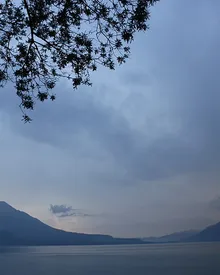
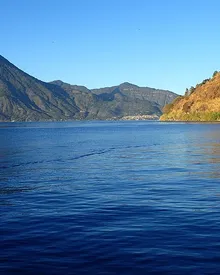
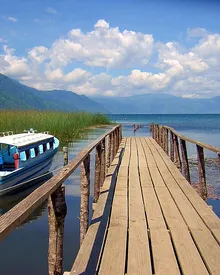
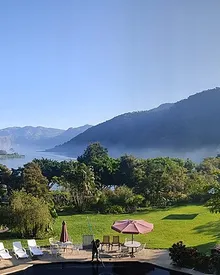
Lake Atitlán sits in the caldera of an ancient supervolcano in the Guatemalan highlands, at 1,562 meters above sea level. Three younger volcanoes rise from its southern shore. Twelve Maya villages run its edge. The water reaches 340 meters at its deepest point and holds a pale turquoise at the rim. By late morning a wind called Xocomil moves across it. By dusk the wind is gone and the lake is a black mirror under the volcano line. People who come here for a weekend often write home from the second week.
The geology: a caldera that became a world
About 84,000 years ago a supervolcanic eruption of extraordinary force collapsed the landscape of what is now the Guatemalan highlands. The resulting caldera filled with rainwater and groundwater over millennia to become Lake Atitlán. The eruption, known as Los Chocoyos, ejected so much material that its ash has been detected as far away as Florida and Ecuador. The three volcanoes you see today, Atitlán (3,535 m), Tolimán (3,158 m), and San Pedro (3,020 m), all grew up afterward, building themselves from the caldera floor. Volcán Atitlán last erupted in the mid-1800s and is considered active; the other two have not erupted in recorded history. The lake covers roughly 130 square kilometers and is the deepest lake in Central America.
The lake is endorheic, meaning it has no surface outlet. Water leaves only through evaporation and underground seepage. A major earthquake in February 1976 fractured the lake bed and the water level dropped about two meters within weeks before stabilizing. That same geological instability is part of why the shoreline towns look the way they do: built carefully on steep caldera walls, connected by water rather than road, arranged around a lake that has always had the final say.
The Maya towns: Tz'utujil, Kaqchikel, K'iche'
The lake sits within the department of Sololá and is surrounded by communities belonging primarily to two Maya peoples: the Tz'utujil, whose main center is Santiago Atitlán, and the Kaqchikel, who are predominant in Panajachel, Santa Cruz, and several other northern-shore towns. K'iche' speakers are present in Sololá and the surrounding highlands. Each community maintains its own linguistic identity, its own textile patterns, its own sacred calendar practices, and its own relationship to the land and water. Spanish is spoken widely but is often a second or third language here.
Santiago Atitlán, the largest lakeside town, is home to the Maximón tradition, a syncretic figure revered by the Tz'utujil who combines pre-Columbian and colonial-era Catholic elements. His shrine moves from house to house each year, tended by a cofradía (a religious brotherhood). Visiting is possible and welcome, but involves a small donation and basic protocols that our Maximón guide covers in full. The lake's broader ceremonial life, including the 260-day Cholq'ij calendar still practiced by Maya spiritual guides, is documented in our Mayan Culture section.
Beneath the lake's current surface, roughly 17 meters down, lies the submerged archaeological site of Samabaj, a pre-Classic Maya ceremonial island that sank when the lake level rose, likely between 250 and 300 CE. Divers with proper permits have documented plaza structures and offering sites. It is sometimes called the Mayan Atlantis in local accounts.
How to get here
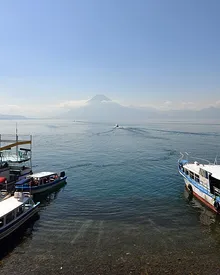
Lake Atitlán is about 120 kilometers west of Guatemala City and roughly three hours by road from Antigua, which is the most common starting point for international travelers. From Antigua, shared tourist shuttles run daily to Panajachel, the main gateway town on the lake's northeast shore. Private transfers are also available. From Guatemala City, the route passes through Chimaltenango and climbs into the highlands through Sololá before descending to Panajachel. From Quetzaltenango (Xela), the drive takes roughly two hours by shuttle. Once you arrive in Panajachel, public lanchas (wooden motorboats) connect the shore towns throughout the day, typically from around 6 AM to 5:30 PM. Our Getting Here guide and our Getting Around guide cover every route, price, and timing detail.
When to visit
The dry season runs from November through April, with the clearest skies and calmest lake conditions from January through March. The rainy season runs from May through October, with afternoon showers that typically clear by evening. Many long-term residents consider the green-season months of June through September some of the most beautiful, when the volcanoes and hillsides are intensely lush and the lake is usually quiet with fewer visitors. The Xocomil wind, which is a strong afternoon gust that can make lancha travel rough, is present throughout the year and typically picks up after midday. Morning is the best time for boat travel or open-water swimming. Our Best Time to Visit guide covers seasonal events, crowd levels, and what to expect month by month.
Twelve villages, twelve different lakes
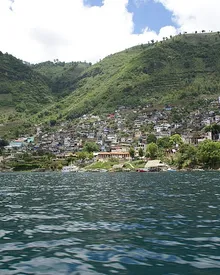
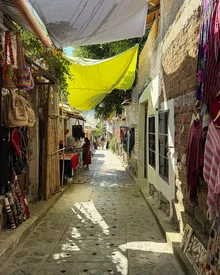
One of the things newcomers learn fast is that there is no single Lake Atitlán. Each town has its own personality, its own pace, its own language, sometimes its own God. Panajachel is the gateway, loud and useful and full of services. San Pedro is where backpackers gather and where the Spanish schools run. San Marcos is the wellness town, yoga at sunrise and ceremony at the new moon. San Juan is where the Tz'utujil weavers work and where the coffee gets roasted at farms that sit between 1,500 and 1,700 meters above sea level. Santiago is the spiritual heart of the lake, home to Maximón and to deep cofradía tradition. Santa Cruz, Jaibalito, and Tzununá are the quiet northern shore, harder to reach and softer once you arrive. All twelve towns are covered page by page, with honest notes on vibe, access, accommodation, and what the town is actually good for.
What you will find on this guide
This site is meant to do one thing well: help you understand Lake Atitlán the way a friend who lives here would. Where the lanchas actually run. Which town fits which kind of trip. What the cofradías do and why it matters that you do not photograph them without asking. Where to spend a long lunch and where to spend a long week. What rents cost in 2026 if you are thinking about staying.
If you are planning a trip, start with Plan Your Trip for getting here, getting around, money, safety, and what to pack for the highlands. If you want to know where to sleep, Stay covers everything from ten-dollar dorms in San Pedro to lakefront retreat centers in Santa Cruz, with honest notes on which is right for which kind of trip. If you are thinking about what to do once you are here, Explore walks you through the volcanoes, the water, the wellness scene, the day trips, and the towns. And if you want to understand the place before you arrive, Mayan Culture is where the Tz'utujil, Kaqchikel, and K'iche' traditions of the lake live on this site, written with care.
Common questions, answered plainly
Is Lake Atitlán worth visiting? Yes. It is one of the most geologically dramatic and culturally layered places in the Americas. The combination of caldera geography, living Maya culture, and the scale of the lake itself is genuinely unusual.
How many days do you need? Five nights is the minimum to get a feel for more than one town. A week lets you settle into a rhythm and explore properly. Many people stay for months. Our 3-day itinerary and 1-week itinerary give structured starting points.
Which town should I stay in? It depends on what you want. Panajachel for services and easy access. San Pedro for budget travel and Spanish school. San Marcos for wellness and quiet. Santiago for deep cultural immersion. Santa Cruz or Jaibalito for near-total peace. Use our town match quiz if you want a fast recommendation based on your priorities.
Can you swim in Lake Atitlán? In many places, yes. Water quality varies by location and season. The northern shore around Santa Cruz and San Marcos tends to be cleaner and is the most popular area for swimming. Our water quality guide explains what to look for and which areas to avoid.
Is it safe? Lake Atitlán is generally safe for travelers who exercise standard awareness. The lake towns themselves have low rates of serious crime. The main caution is hiking between towns on mountain trails without a guide, where isolated robberies have been reported. Our safety guide is detailed and honest.
What languages are spoken? Spanish is the common language of commerce and inter-town communication. In most lakeside communities, Tz'utujil or Kaqchikel is the primary home language. English is spoken in tourist-facing businesses throughout Panajachel, San Pedro, and San Marcos. Our language guide includes basic phrases in Kaqchikel and Tz'utujil that locals genuinely appreciate.
Why we built this
Most of the internet about Lake Atitlán is either out of date, extractive, or both. A post from 2019 tells you to stay at a hotel that closed in 2021. A booking aggregator with no presence at the lake collects the commission, and the money leaves before you even check in. Spanish-language travelers, who make up half of the people who actually live and work here, get nothing useful in their own language. We think that is a small disaster repeated a thousand times a day, and we built this site to be the opposite of all of it. Bilingual from day one. Locally written and locally maintained. Updated when things change, not when an editor remembers a backlink. Honest about what is good and what is not. The full About page goes deeper if you are curious how we work and who writes what.
Where to start, depending on who you are
If this is your first time at the lake and you have a week, start with how to get here and then read the town overviews to choose a base. If you have been here before and you want to go deeper, the Mayan Culture pages and the festival calendar are where the lake's calendar shows itself most clearly. If you are thinking about staying for a season or longer, the long-term housing guide is honest about how rent and rhythm actually work at the lake. And if you came in through a Spanish-language search, the entire site exists in Spanish at the same depth.
This is not a list of the best things to do.
You will find lists on this site, but they are not the point. The point is the place. The point is the woman in San Juan who wakes up at four to grind cacao for the chocolate she sells at noon, and what it means that you might walk past her without noticing. The point is the way the water turns silver before a storm and the way the volcanoes wear cloud like a hat. The point is that there is a real, living, contemporary Mayan culture at this lake, that it has survived a great deal, and that how visitors behave matters to whether it keeps surviving. We are trying to write a guide that takes that seriously, and that still gives you everything you need to plan a great trip. Both, at the same time, in two languages, and updated as the lake changes.
Welcome. Take your time. The lake is patient.