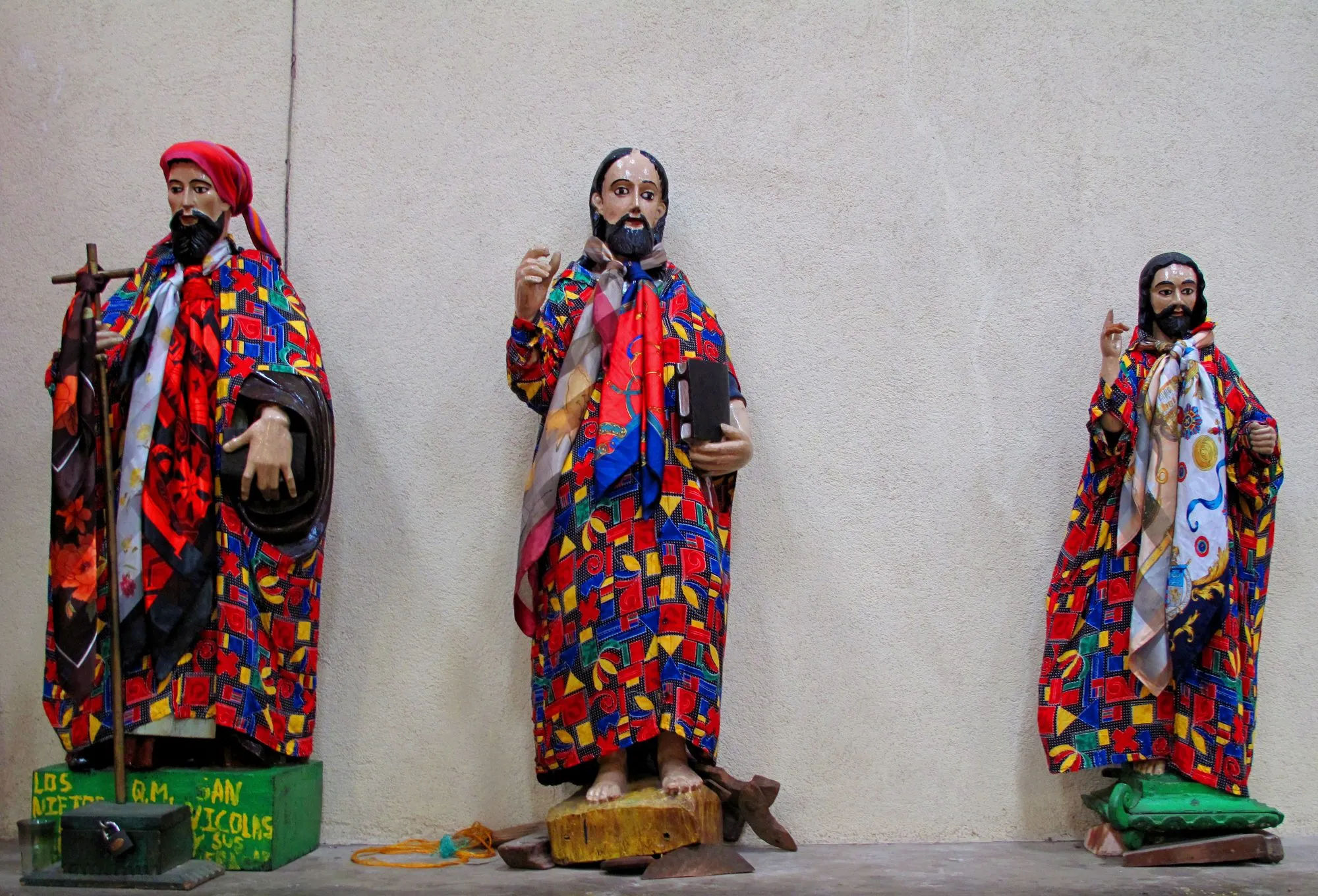
Maya Ceremonies at Lake Atitlan: A Respectful Visitor Guide
Maya ceremonies at Lake Atitlán, including fire ceremonies, cofradía observances, and visits to Rilaj Mam (Maximón), are living spiritual practices, not tourist performances. Some fire ceremonies are open to visitors through community-based tourism channels, but private ceremonies always require an invitation from the presiding Ajq'ij or cofradía authority. Photography inside cofradías typically requires explicit permission and a small fee of Q10 to Q20 (about $1.30 to $2.60 USD).
Maya spiritual guides called Ajq'ij preside over ceremonies according to the 260-day Chol Q'ij calendar. At Santiago Atitlán, Rilaj Mam (Maximón) rotates annually among eleven cofradías, and visits require locating the current house through a local guide. Photography inside cofradías usually needs explicit permission and a small fee, roughly Q10 to Q20 (about $1.30 to $2.60 USD).
This guide draws on peer-reviewed anthropological scholarship and official institutional sources. It is written for visitors who want to engage honestly with what they are seeing, not package it as an "authentic experience."
Maya spirituality as a living tradition
The Academia de las Lenguas Mayas de Guatemala (ALMG) was created by Decreto No. 65-90 of the Congress of Guatemala, signed October 18, 1990, as "an autonomous state entity of technical, scientific and cultural character, whose purpose is to promote knowledge and diffusion of Maya languages and culture." Its mandate covers research, standardization, and dissemination of Maya languages across all 22 recognized Maya linguistic communities of Guatemala.
Barbara Tedlock, who trained as a practicing daykeeper in Momostenango during fieldwork in the 1970s and 1980s, documented in Time and the Highland Maya (University of New Mexico Press, revised 1992) that "despite five centuries of colonial suppression, aj k'in daykeepers in the K'iche', Kaqchikel, and Ixil communities of highland Guatemala maintained an unbroken count" that "matched the Classic-period Tzolk'in to the day." This is not historical continuity in a museum sense. These are living people maintaining a living calendar.
Maya spiritual practices were systematically suppressed during Guatemala's internal armed conflict (1960 to 1996), during which Maya communities bore a disproportionate share of state violence. The UNESCO safeguarding file for the Nan Pa'ch ceremony explicitly cites armed conflict as having nearly caused the tradition's disappearance. That historical context explains why Maya communities are protective of their ceremonial spaces, and why revitalization is a matter of cultural survival, not a tourism brand.
The Chol Q'ij: the 260-day sacred calendar
To understand any Maya ceremony, you need to understand the calendar that governs it. The Smithsonian's Living Maya Time project describes the 260-day sacred calendar (Tzolk'in in Yucatec Mayan, Chol Q'ij in K'iche') as "a succession of 20 day glyphs in combination with the numbers 1 to 13," generating 260 unique days. The calendar duration corresponds to nine lunar cycles, the human gestational period, and the corn growing cycle, making it simultaneously cosmological, agricultural, and biological.
Specific ceremonies are tied to specific days in the Chol Q'ij. An Ajq'ij (Maya spiritual guide and daykeeper) reads the calendar, determines the correct day for a ceremony, and presides. If you encounter a ceremony at Lake Atitlán, it is happening on that day for reasons embedded in a cosmological system with documented continuity going back to the pre-Classic Maya period.
The Ajq'ij: who actually leads ceremonies
The Ajq'ij (plural: Ajq'ijab) is the Maya spiritual practitioner who serves as keeper of the Chol Q'ij and conducts ceremonial life. The word means "one who works with the days."
Daniel Croles Fitjar's Balancing the World (Peter Lang, 2015), based on direct interviews with nine practitioners in Quetzaltenango, defines the role: Ajq'ijab "cure and avert illness, perform divinations, communicate with the ancestors, and do their part in balancing the world." Tedlock's fieldwork confirmed that daykeepers "cure the sick, introduce newborn children into the world, arrange weddings and funerals, perform ceremonies for the dead and local plantation and harvest rituals according to the tzolkin." The specialist role is not self-declared. It is conferred through community recognition, and most practitioners report having been chosen, often at birth according to the Chol Q'ij, rather than having self-selected.
One important note on terminology: do not describe an Ajq'ij as a "shaman." That word comes from the Evenki language of Siberia and is not a Maya category. ALMG and Maya cultural organizations consistently use "guía espiritual" (spiritual guide) or "sacerdote maya" (Maya priest) in Spanish. In English, use "Ajq'ij" or "Maya spiritual guide."
Lina Barrios, an anthropologist and practicing Maya Ajq'ij, has spent nearly 25 years working on preservation of traditional Maya languages, women's rights, and spirituality. Her published academic work includes "Tras las huellas del poder local" (IDIES / Universidad Rafael Landivar, 2001). She is one example of the many people who hold both academic and practitioner roles simultaneously.
Types of ceremonies you may encounter
Fire ceremony (Fuego Sagrado)
The most commonly observed ceremony type. Offerings are burned in a ritual fire on specific Chol Q'ij calendar days. Offerings typically include candles in colors representing individual nawales (spiritual energies tied to calendar signs), copal incense, sugar, tobacco, and sometimes flowers. An Ajq'ij presides. These ceremonies are conducted at known sacred sites around the lake and in highland towns.
Wajxaqib' B'atz (8 B'atz): the Maya new year
Every 260 days, Ajq'ijab in the highlands celebrate a new year ceremony in which new daykeepers are initiated. The Smithsonian's Living Maya Time project documents this as the primary ceremony at which the next generation of Ajq'ijab is formally recognized.
Agricultural ceremonies and Nan Pa'ch
The Nan Pa'ch ceremony is a corn-veneration ritual of the Mam Maya people in San Pedro Sacatepequez, San Marcos, inscribed on UNESCO's Urgent Safeguarding List in 2013. UNESCO describes it as giving "thanks for good harvests in a ritual that highlights the close connection between humans and nature." It is on the Urgent Safeguarding List because practitioners are primarily elderly farmers and youth engagement is declining. This is not a ceremony you can drop into as a visitor. It is cited here to illustrate the broader agricultural ceremonial cycle that shapes life throughout the highlands.
Rabinal Achi (Xajoj Tun): the dynastic dance drama
The Rabinal Achi Dance Drama, performed annually in Rabinal, Baja Verapaz on January 25, was inscribed on UNESCO's Representative List of Intangible Cultural Heritage in 2008. UNESCO calls it "a rare example of preserved pre-Columbian traditions" combining masked dance, theater, and music. The Ministry of Culture and Sports has been actively supporting its preservation through material delivery to custodian communities as recently as January 2026. Performances are organized by local cofradías and are public, though visitors should arrive with awareness that they are attending a sacred community event.
Divination sessions
Individual ritual consultations with an Ajq'ij use tz'ite seeds and calendar knowledge for healing, life decisions, and communicating with ancestors. Fitjar's research documents these as deeply personal appointments, not performances. If someone arranges a divination session for you through legitimate community tourism channels, treat it accordingly.
The cofradía system at Santiago Atitlán
The cofradía (Spanish: cofraternity) system was introduced to Guatemala by Franciscan missionaries in 1533 as a mechanism of Christianization. At Santiago Atitlán, which the Municipalidad's own historical record notes "was founded in 1541 by Franciscan friars on Tz'utujil lands," the system fused with existing Maya spiritual practice rather than replacing it.
Vincent James Stanzione's fifteen-year ethnographic study, Rituals of Sacrifice (University of New Mexico Press, 2003), describes the eleven Santiago Atitlán cofradías as "the present-day heart of Traditionalist Tz'utujil Maya community, ritual, and an unbroken lineage of ancient Mayan ways." In Tz'utujil, the cofradías are called "Armit Jay," meaning Sacred or Holy Houses. There are also two ancestral Ceremonial Houses.
Allen J. Christenson's Art and Society in a Highland Maya Community (University of Texas Press, 2010) documents how the reconstruction of Santiago Atitlán's central church altarpiece by Maya artists, working with village elders, produced what functions as "a Maya Christian cosmogram," in which Catholic form and Maya iconography are inseparable. The physical sacred space of the town's sixteenth-century church is itself a ceremonial object.
Cofradía interiors are private spaces. Entry requires an invitation or explicit permission. Many ceremonies held in cofradías are not open to visitors. Do not assume that because a door is open, you are welcome through it.
Maximón / Rilaj Mam at Santiago Atitlán
Maximón, known to Tz'utujil traditionalists as Rilaj Mam ("Great Grandfather" or "Wise Venerable One"), is a living spiritual figure at the center of Tz'utujil religious life. The name Maximón derives from the original word Maxmuen, meaning "bundled or tied one."
Alberto Vallejo Reyna's monograph Por los caminos de los antiguos nawales (Instituto Nacional de Antropología e Historia, Mexico City, 2020) examines "Tz'utujil mythology, nagualism, ritual observances, and the religious customs of this indigenous community" centered on the Rilaj Mam tradition. David M. Schaefer's peer-reviewed article in Revista UVG (Vol. 47, 2025) presents the scholarly debate on origins: "while the physical formation and formalization of the Mam tradition may be relatively recent, such as in the 19th century," the underlying "mythological roots are ancient," with possible connections to Classic Maya deity God L and the Wayeb' calendar period.
At Santiago Atitlán, Rilaj Mam resides in one of the eleven cofradías and rotates annually among households of cofradía members. To visit, you need to find the current cofradía where he is housed. This changes each year. A local guide or a trusted contact in town is the right way to locate him. Treat the visit as you would any respectful encounter with a sacred figure in any living tradition.
Photography: the short version
The rule is ask first, accept no as the answer, and do not photograph anyone without verbal permission.
Cofradía interiors: many prohibit photography. Ask the mayordomo (cofradía leader) before raising a camera. Expect that the answer may be no. For a visit to Rilaj Mam, photography typically requires explicit permission from the cofradía attendant and involves a small fee (Q10 to Q20, approximately USD 1.30 to 2.60 at the Banco de Guatemala reference rate of Q7.625 per USD as of May 2026). Video may be restricted separately. Ask each time.
Sacred sites during ceremony are generally off-limits to photography. At processions, do not photograph participants close-up without asking. Never photograph elderly women or people in ceremony without explicit verbal permission. If someone declines, move on.
Practical protocols before, during, and after a ceremony
Before attending
Any participation in a ceremony requires an invitation or explicit permission from the presiding Ajq'ij or cofradía authority. There is no anonymous attendance at private ceremonies. Community-based tourism at Lake Atitlán operates through local organizations; approach through formal channels rather than appearing unannounced. Dress modestly: cover shoulders and knees in all religious and ceremonial spaces.
Inside a cofradía
Remove hats upon entering. Greet your hosts. A small offering (candle, incense, or flowers) is appropriate. Do not arrive empty-handed. Speak quietly. Do not touch altars, sacred objects, or offerings. Ask cofradía attendants before sitting or moving to different areas. If a ceremony is in progress and you were not previously invited, wait or withdraw.
What not to do
Several prohibitions are well documented across the academic and community literature:
Do not describe ceremonies as "shamanic rituals," "magic shows," or "authentic experiences" packaged for tourism. Do not approach an Ajq'ij demanding to participate in a private ceremony. Do not walk on ceremonial spaces, offerings, or alfombras (the sawdust carpets laid during processions). Do not bring large groups without advance coordination. Do not photograph cofradía interiors without explicit permission from the mayordomo. Do not purchase sacred objects, ceremonial textiles, or ritual items as souvenirs. That actively harms the continuity of these traditions. And do not treat the visit to Rilaj Mam as a party or photo opportunity.
Modern revitalization and UNESCO recognition
Guatemala has four elements on UNESCO's Intangible Cultural Heritage lists as of 2026:
- Rabinal Achi Dance Drama Tradition (Representative List, 2008)
- Nan Pa'ch Ceremony, Mam Maya (Urgent Safeguarding List, 2013)
- Holy Week in Guatemala (Representative List, 2022)
- Technique of Making the Giant Kites of Santiago Sacatepequez and Sumpango (Representative List, 2024)
ALMG maintains 22 linguistic community offices corresponding to the 22 recognized Maya languages of Guatemala. Its institutional framework provides the legal basis for recognizing Maya cultural expressions as having standing in Guatemalan public life.
The INGUAT Plan Maestro de Turismo Sostenible 2026 to 2036 states that tourism development must prevent "the folklorization of ancestral knowledge" and must safeguard sacred sites. That framing, from the national tourism authority, reflects a recognition that cultural tourism and cultural harm can be the same thing if the visitor does not take responsibility for the difference.
Frequently asked questions
Can tourists attend Maya fire ceremonies at Lake Atitlán? Some are open to visitors through community-based tourism channels, but private ceremonies require an invitation from the Ajq'ij. Ask through a reputable local guide and accept whatever answer you receive.
Is the Rilaj Mam (Maximón) visit open to the public? Yes, visitors are generally welcomed to the cofradía currently housing Rilaj Mam, though it is not a conventional tourist attraction. A small offering is expected, and photography requires explicit permission plus a small fee.
Should I hire a guide for Maya ceremonies? Yes, for anything beyond viewing a church or cofradía from outside. A local guide can confirm whether you are welcome, arrange proper introductions, and help you avoid inadvertently causing offense.
What is the difference between a cofradía and a Maya ceremony?
A cofradía is a sacred house and organizational structure, part of the community governance system at Santiago Atitlán and other highland towns. Maya ceremonies (fire ceremonies, agricultural rituals, divination sessions) are ritual acts performed according to the Chol Q'ij calendar by an Ajq'ij. Some ceremonies take place inside cofradías. Some cofradías conduct Catholic observances that have fused with Maya practice. The two overlap significantly at Santiago Atitlán.
Is it appropriate to participate in a divination session as a non-Maya person?
Some Ajq'ijab do conduct divination sessions for non-community members, and these can be arranged through community-based tourism channels. The key is that the arrangement comes through legitimate channels, that you approach the session with respect for what it actually is (a sacred consultation, not a performance), and that you do not treat the experience as content for social media.
Sources
- ALMG, Decreto No. 65-90, Ley de la Academia de las Lenguas Mayas de Guatemala. Accessed 2026-05-20.
- ALMG, Funciones y Atribuciones Generales. Accessed 2026-05-20.
- UNESCO, Rabinal Achi Dance Drama Tradition, Representative List No. 00144. Accessed 2026-05-20.
- UNESCO, Nan Pa'ch Ceremony, Urgent Safeguarding List No. 00863. Accessed 2026-05-20.
- UNESCO, Guatemala intangible heritage elements overview. Accessed 2026-05-20.
- Municipalidad de Santiago Atitlán, Historia del Municipio. Accessed 2026-05-20.
- INGUAT, Plan Maestro de Turismo Sostenible 2026-2036. Accessed 2026-05-20.
- Smithsonian National Museum of the American Indian, The Calendar System, Living Maya Time. Accessed 2026-05-20.
- Ministerio de Cultura y Deportes, MCD fortalece la preservación del Rabinal Achi, 2026-01-12. Accessed 2026-05-20.
- Banco de Guatemala, Tipos de Cambio de Referencia. Accessed 2026-05-20.
- Tedlock, Barbara. Time and the Highland Maya. University of New Mexico Press, revised edition 1992. ISBN 9780826305770. Publisher record.
- Stanzione, Vincent James. Rituals of Sacrifice: Walking the Face of the Earth on the Sacred Path of the Sun. University of New Mexico Press, 2003. ISBN 0826329160. Stanford catalog.
- Christenson, Allen J. Art and Society in a Highland Maya Community: The Altarpiece of Santiago Atitlan. University of Texas Press, 2010. ISBN 9780292789838. Publisher record.
- Vallejo Reyna, Alberto. Por los caminos de los antiguos nawales: Rilaj Mam y el nawalismo maya Tz'utuhil de Santiago Atitlan, Guatemala. INAH Mexico City, 2020. ISBN 9786075394299. Stanford catalog.
- Fitjar, Daniel Croles. Balancing the World: Contemporary Maya 'ajq'ijab' in Quetzaltenango, Guatemala. Peter Lang Group AG, 2015. ISBN 9783631654736. Publisher record.
- Schaefer, David M. "Re-framing the Rilaj Mam in Santiago Atitlan." Revista UVG, Vol. 47, 2025, pp. 192-207. Academia.edu.
Leave a comment
Comments are reviewed before publishing.
See something to fix or add?
Goes straight to our editors. Not shown publicly.
Comments (0)
No comments yet. Be the first.