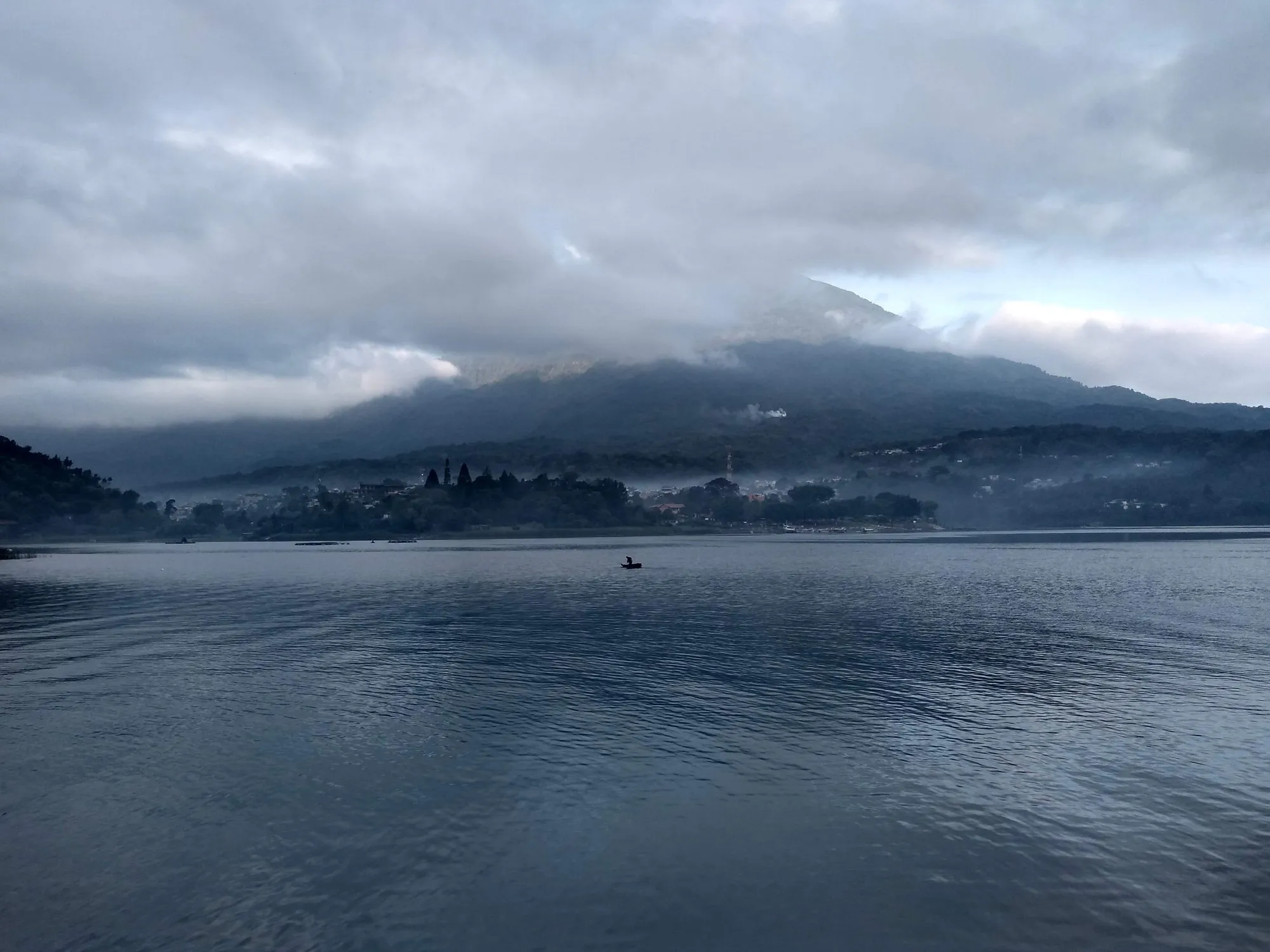
Lake Atitlan Rainy Season 2026: Months, Risks, Rewards
Lake Atitlán's rainy season runs May through October, and it is far more visitable than most guides admit. Rain typically falls between 2 p.m. and 6 p.m. while mornings stay clear and sunny, September is the wettest month by a wide margin (averaging 350 to 384 mm of rain, per INSIVUMEH, Guatemala's national meteorological institute) with the highest landslide risk, and accommodation runs roughly 30 to 40 percent below dry season peaks. The trade is real: vivid green volcanoes and empty villages in exchange for disrupted afternoons and genuine landslide risk in September.
The rainy season at Lake Atitlán runs roughly from May through October. INSIVUMEH (Guatemala's national meteorological institute) officially defines this period as the "época lluviosa." The dry season covers November through April. Here is what the rainy season actually looks like, month by month, with official data.
Month-by-Month Rainfall Outlook
The following figures come from aggregated climate databases that draw on historical INSIVUMEH and WMO station data for the Panajachel meteorological station. Annual precipitation at Panajachel totals approximately 2,231 mm per year, giving the lake basin a Köppen Cwb classification (oceanic climate with a dry winter). The lake's climate is influenced year-round by the Xocomil wind, a regional afternoon phenomenon driven by Pacific-highland temperature differentials.
| Month | Avg Precipitation | Temp Range | Season Notes |
|---|---|---|---|
| January | 14 to 16 mm | 11 to 24 °C | Deep dry season, clearest skies |
| February | 10 to 15 mm | 11 to 25 °C | Dry season peak |
| March | 15 to 20 mm | 12 to 26 °C | Dry but Xocomil wind strongest |
| April | 30 to 40 mm | 13 to 26 °C | Transition month, late-afternoon showers begin |
| May | 120 to 140 mm | 14 to 26 °C | Rainy season begins, prices drop |
| June | 180 to 220 mm | 14 to 25 °C | Heavy afternoon storms, much quieter |
| July | 150 to 190 mm | 14 to 25 °C | Possible canícula dry spell mid-month |
| August | 160 to 200 mm | 14 to 25 °C | Consistent rain, good for families |
| September | 350 to 384 mm | 14 to 24 °C | Wettest month, highest flood/slide risk |
| October | 180 to 220 mm | 13 to 24 °C | Still wet early, improves late month |
| November | 40 to 60 mm | 12 to 24 °C | Transition, landscape still deep green |
| December | 14 to 20 mm | 11 to 24 °C | Dry season returns |
Note: These figures are derived from climate aggregation databases and should be cross-referenced against the INSIVUMEH Atlas Climatológico before any formal publication. The pattern described is consistent with INSIVUMEH's regional outlook documents.
Year-round temperatures at the lake "rarely above 26 °C or below 14 °C," per Fuego Atitlán's official seasons guide. Elevation (the lake surface sits at 1,562 metres) keeps the climate mild even in July and August, when Guatemala's lowlands are oppressively humid.
What the 2026 INSIVUMEH Forecast Actually Says
For the 2026 rainy season specifically, INSIVUMEH and CONRED jointly presented key findings relevant to the Lake Atitlán basin. The western highlands (Occidente) region was characterized as having an "anticipated" (early) rainy season onset. Lake Atitlán sits at the boundary of the Occidente and Central Highlands (Altiplano Central) climate zones.
The forecast projects precipitation "below historical average" for both the Central Highlands and Occidente regions in 2026, with an 88% probability of transition toward El Niño conditions (warming of Pacific waters). El Niño years typically reduce precipitation in Guatemala's western highlands. As summarized by Diario de Centro América citing INSIVUMEH, the canícula (mid-summer dry spell) for the Central Highlands is projected during weeks 4 of June through week 1 of July 2026.
In practical terms: the 2026 rainy season may be drier than usual overall. This reduces but does not eliminate the risks described below.
The Real Pros of Visiting in Rainy Season
Lower prices and better availability. Fuego Atitlán's official seasons page states directly: "The rainy season also offers the best availability and rates." Shoulder season months (May to June and September to October) are described as offering "fair prices." AirROI market data for San Pedro La Laguna confirms that September is the lowest occupancy month across the lake (26.7% average), compared to March's peak of 54%. Third-party booking aggregators suggest rainy season accommodation rates 30 to 40% below December-through-February peaks, though this is not confirmed by official hotel rate sheets.
A genuinely beautiful landscape. The lake's slopes are covered in coffee, avocado, and milpa corn. Consistent rainfall from June through September turns the volcanic hillsides an intense, saturated green. The dry season's dusty hillsides do not compare. When dramatic cumulonimbus clouds build above Volcán Atitlán and Volcán Tolimán each afternoon, the scenery has a scale that photography struggles to capture.
Far fewer tourists. INGUAT national visitor data shows October as a weaker month (October 2023 was down 7% year-on-year). Longtime lake residents consistently describe September and October as their favorite months for the atmosphere of the towns, uncrowded restaurants, and the ease of getting around. If you want the lake to yourself, September and October are the months.
Morning weather is often excellent. Rain during the rainy season predominantly falls in the afternoon, typically from around 2 PM to 6 PM. Mornings are frequently clear and bright. A morning schedule (hike before noon, retreat to a café or your hotel by 2 PM) makes the rainy season workable for most itineraries.
Cultural events during the season. Several of the region's most significant festivals fall within the rainy season period:
| Date | Event | Location |
|---|---|---|
| May 3 | Día de la Santa Cruz | Lake-wide, centered in Tzununa/Santa Cruz La Laguna |
| June 29 | Fiesta Patronal San Pedro Apóstol | San Pedro La Laguna |
| July 25 | Fiesta Patronal Santiago Apóstol | Santiago Atitlán |
| September 15 | Día de Independencia | Nationwide, all lake towns |
| October 1 to 7 | Feria Patronal San Francisco de Asís | Panajachel |
Sources: SIC Guatemala, Guatemala.com, and INGUAT festival directories.
The Real Cons: What You Actually Risk
Landslide and flooding history. This is not theoretical. CONRED and INSIVUMEH classify Sololá Department as having high landslide susceptibility due to its volcanic slopes, proximity to three active or dormant volcanoes, and steep terrain. The historical record is sobering:
On October 5, 2005, Tropical Storm Stan caused catastrophic landslides in the Panabaj and Tzanchaj cantons of Santiago Atitlán municipality. CONRED's official count: approximately 212 confirmed deaths, more than 800 people missing and presumed buried, 927 families displaced, and over 2,600 people relocated permanently. As Agencia Ocote reported on the 20th anniversary, the affected zone was declared uninhabitable. CONRED stated at the time that more than 90% of Sololá's population lived at risk due to irregular topography.
In September 2002, a landslide in El Porvenir, San Lucas Tolimán municipality, sent mud, trees, pyroclastic material, and large rocks down from Volcán Atitlán, as documented in a ReliefWeb CONRED field report.
More recently, national 2023 rainy season data from CONRED showed 885 incidents nationwide, with 6,297 people left homeless. In 2025, CONRED responded to over 2,000 emergency responses nationally, though Sololá was not listed among the four most-affected departments.
This history does not make the rainy season off-limits. But it means paying attention to CONRED alerts during September in particular, choosing accommodation away from steep hillsides, and being aware of evacuation routes.
Lancha service disruptions. The Xocomil wind is a documented meteorological feature of Lake Atitlán, described in Wikipedia's lake entry as blowing from the southwest during late morning and afternoon hours. During rainy season, afternoon thunderstorms amplify this effect. Services can and do get suspended.
A January 2026 incident reported by Publinews.gt illustrates the risk: a lancha capsized in strong winds, killing two Panamanian tourists. The Marina de la Defensa Nacional recommended suspending all services. While this occurred during dry season and represents an extreme event, it confirms that strong wind events are an operational reality regardless of season.
The practical implication: morning lanchas (roughly 6 AM to 11 AM) are generally calm. Afternoon crossings after 1 to 2 PM carry more weather risk. Check conditions at the dock rather than assuming service is running. This is basic lake etiquette that any experienced lancha captain will confirm.
Trail accessibility. Volcano hikes (Volcán San Pedro in particular) become more challenging in heavy rain. Views from summits are frequently obscured by cloud cover during rainy months. Trail conditions on steep volcanic slopes deteriorate after sustained rain. No official CONAP (Consejo Nacional de Áreas Protegidas) seasonal closure schedule for volcano trails was confirmed during research; check with local tour operators before booking any summit hike during September or October.
Variable cloud cover. September in particular can bring extended periods of overcast skies without the classic clear-morning pattern. For photography-focused trips, September is the highest-risk month for poor light.
Who the Rainy Season Is Actually For
The rainy season works well for:
- Budget travelers. Lower hotel rates and a quieter atmosphere at restaurants and markets.
- Long-stay visitors. Expats, remote workers, and students at Spanish schools. The morning rain pattern is very manageable over weeks, and the savings on accommodation and restaurant prices add up.
- Nature and landscape photographers. The green season, despite (because of) the dramatic weather, produces images that dry-season photographers never get.
- Travelers who have already visited in dry season and want to see a different side of the lake.
The rainy season is more challenging for:
- Travelers with tight itineraries and fixed activities. Afternoon plans will regularly be disrupted.
- First-time visitors to Guatemala with limited flexibility. A dry-season first visit is a safer choice for building familiarity with the lake.
- Anyone planning volcano summits as a primary goal. October through March offers far better summit conditions.
Practical Planning for Rainy Season Travel
Schedule boat travel for mornings. If you need to cross between towns, aim to arrive at the dock by 10 AM. Give yourself flexibility in the afternoon.
Book accommodation with covered outdoor space. An open terrace is a joy in morning sun. Without a roof or awning, it is useless by 3 PM.
Carry a compact rain jacket rather than an umbrella. Lanchas and narrow village paths make umbrellas impractical.
Pack layers for evenings. Even in July and August, lakeside temperatures after sunset drop noticeably. A light fleece or sweater is useful from May through October.
Follow CONRED alerts during September. The CONRED website publishes active emergency bulletins. If you are visiting in September, check it the way you would check a weather app.
Frequently asked questions
What is the rainy season like at Lake Atitlan? Clear to partly cloudy mornings followed by afternoon and evening rain, typically from 2 p.m. to 6 p.m. September is the exception, when sustained all-day cloud cover and rain become more common.
What is the rainiest month in Guatemala? September. At Lake Atitlán it averages 350 to 384 mm of rainfall, the highest flood and landslide probability of the year, and the most frequent lancha disruptions.
Is it worth going to Lake Atitlan in rainy season? Yes, for budget travelers, long stays, photographers and returning visitors: hotels are cheaper, villages are quiet, and the landscape is at its greenest. First-time visitors on tight itineraries should prefer the dry season.
Sources
- INSIVUMEH, perspectiva climática 2026 (Diario de Centro América), accessed 2026-05-20
- INSIVUMEH, temporada lluviosa 2026 press release, accessed 2026-05-20
- Wikipedia, Lake Atitlán (Xocomil wind), accessed 2026-05-20
- Fuego Atitlán, seasons and weather guide, accessed 2026-05-20
- AirROI, San Pedro La Laguna Airbnb market data, accessed 2026-05-20
- CONRED, departamentos más afectados época de lluvia 2025, accessed 2026-05-20
- Wikipedia, Huracán Stan (CONRED data), accessed 2026-05-20
- Agencia Ocote, Panabaj 20th anniversary, accessed 2026-05-20
- ReliefWeb, deslave El Porvenir, San Lucas Tolimán 2002, accessed 2026-05-20
- CONRED, emergencias temporada lluvias 2023, accessed 2026-05-20
- Publinews.gt, lancha accident January 2026, accessed 2026-05-20
- SIC Guatemala, Feria Patronal Panajachel, accessed 2026-05-20
- Guatemala.com, Fiesta Patronal San Pedro La Laguna, accessed 2026-05-20
- INGUAT, record de visitantes 2024 (AGN), accessed 2026-05-20
Leave a comment
Comments are reviewed before publishing.
See something to fix or add?
Goes straight to our editors. Not shown publicly.
Comments (0)
No comments yet. Be the first.