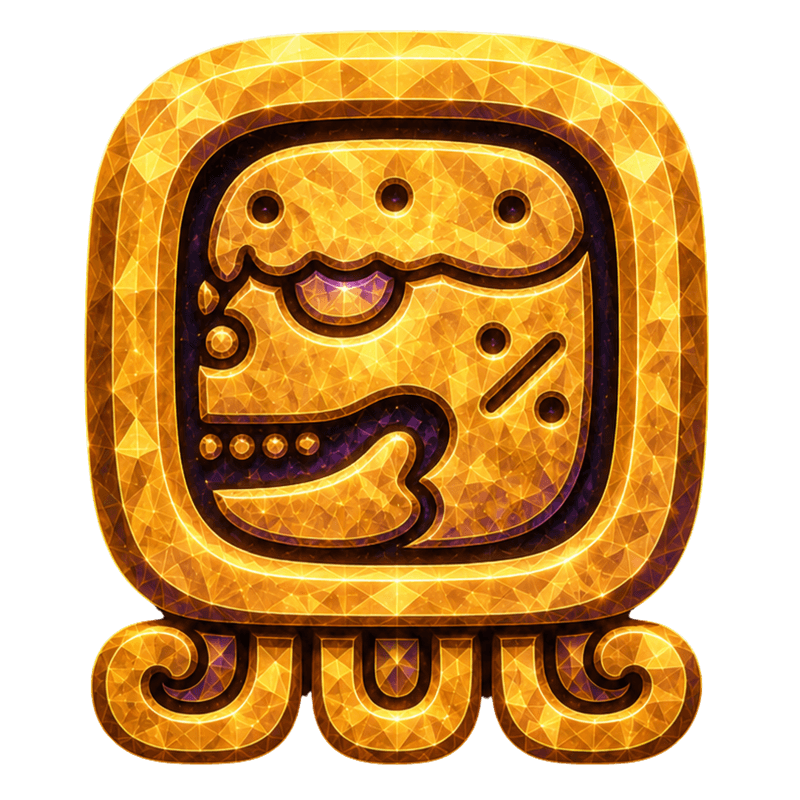
Nawal Kame
Death / Transition · Endings as gateways. Honoring those before us.
The nawal Kame, also searched as Kimi, is the Maya day sign of the Cholq'ij associated with death / transition. In short: Transition, the bridge, the ancestor path. Endings as gateways. Honoring those before us.
You are not afraid of endings. Kame people carry the energy of transition: the passage between what was and what will be. You have likely already had to let things die: relationships, identities, chapters of your story. You know better than most that endings are not punishments. They are doors.
Your gifts are depth, resilience, and an unusual connection to what lies beyond ordinary awareness. Ancestors speak through Kame. You may sense the presence of those who have gone before you, and that is not imagination. It is your nawal at work. You are a bridge, and that is a real form of power.
The challenge for Kame is getting stuck in what ended: circling the ruins of what used to be instead of continuing. The ancestors who move through you want you to keep walking, not to make a home in the past. Grieve what needs grieving, fully and without apology. Then move.
What does the nawal Kame mean?
The nawal Kame, also searched as Kimi, is the Maya day sign of the Cholq'ij associated with death / transition. In short: Transition, the bridge, the ancestor path. Endings as gateways. Honoring those before us.
| K'iche' name | Kame |
|---|---|
| Yucatec / public variant | Kimi |
| Commonly searched as | Kame, Kame, Kimi, kame, maya nawal, nahual maya, nahual, maya day sign, maya zodiac |
| Calculate your date | Use the Maya nawal calculator |
Your nawal is only half of a day in the Cholq'ij. Every sign is paired with a number from 1 to 13 that changes its intensity and timing. This is not a Maya zodiac of 12 fixed signs, it is a living 260 day count. See how the 13 numbers work, or calculate your nawal and your number.
Go deeper: the documented teaching
What Kame represents
Kame is the nawal of death, transformation, and the ancestors within the Maya Tzolk'in. It takes in both the ending and the crossing itself: the owl that signals death, the passage between states, and, in Komon Tohil's account, the entire range of good and bad as a nawal belonging to the Sun. This first pass draws its meaning chiefly from the Komon Tohil K'iche' daykeeper tradition, and keeps the Yucatec/Classic naming and the separate Dreamspell seal language apart from that core meaning.
Its strengths
- Fortitude when facing consequence, endings, and the mixed nature of life itself.
- Carries a Traditional day/nawal meaning that can later be paired with a coefficient running from 1 to 13.
Its shadow side
- Can bear suffering too heavily or treat every threshold as a danger.
- Treating this as a fixed, universal template for Maya personality would go beyond what the source material actually supports.
Its path forward
Ask what needs to be let go of, so that choices and accidents do not end up steering the path instead. Within the wider calculation, the day/nawal ought to carry the core Traditional meaning, with the coefficient shaping how strongly or when it lands.
Where traditions differ
In K'iche' the sign is written Kame, while Yucatec and Classic-era public sources record it as Kimi. The gloss given in the English source field reads: death, owl, sun nawal. Dreamspell assigns a separate seal label to the same index, and that should not be used to define this node's meaning. The Komon Tohil source lists day meanings in a table that begins with B'atz', whereas GMT calculation may instead run an internal sequence beginning with Imix/Imox.
What does the Kame nawal mean in Maya tradition?
Kame is the sixth day sign of the traditional Cholq'ij. Death, within Maya cosmology, is not life's opposite, it is a passage, a shift from one state into another, overseen by the Xibalba lords of the underworld and watched over by ancestors who have already made that same crossing. The owl that Komon Tohil links to Kame is a night flying bird, one that sees what daylight hides and gives warning of transitions before anyone else can spot them.
The phrase "encompassing good and bad" in Komon Tohil's account matters here: Kame is not a negative sign. It marks the full range of things. Daykeepers who work with Kame days turn towards the ancestral realm, petitions for the departed, the healing of grief, and the release of burdens carried down across generations. Its link to the Sun reflects that the crossing Kame stands for is, at bottom, a solar one, down into the underworld and back up into the light, tracing the very path the Sun follows each night.
How does Kame relate to the other nawales?
Kame follows Kan, the feathered serpent of creative vitality and justice, and comes before Kej, the deer, the four directions, and structural foundation. That order teaches something: the vitality Kan builds arrives at the threshold of ending in Kame, and out of that crossing comes the stable, four cornered world of Kej. Nothing built to last can skip the field of what must first come to an end.
The Nawal Calculator will find the next Kame day in the current cycle. For how the 13 tonal coefficients shape this day sign's energy, visit the Tzolk'in Tones hub. The ancestral bond with the dead is most visible at the lake in Santiago Atitlán, where Day of the Dead, held on 1 and 2 November, brings offerings at the church cemetery and the cofradía houses, carrying forward patterns of ancestor honouring that go back before the colonial Catholic layer was added.
Nawal Kame: frequently asked questions
What does the nawal Kame mean?
The nawal Kame, also written Kimi, is one of the 20 day signs of the sacred Maya calendar, the Cholq'ij. Transition, the bridge, the ancestor path. Endings as gateways. Honoring those before us.
How do I find my nawal? Is Kame my Maya day sign?
Enter your birth date in the nawal calculator. If your Cholq'ij day sign comes out as Kame, that is your nawal. This is not a Western horoscope with 12 star signs, it is a Maya calendar birth day drawn from a 260 day cycle. Use the nawal calculator to work out your own day sign and number.
Are Kame and Kimi the same day sign?
Yes. Kame is the K'iche' spelling kept by the Ajq'ijab' (day keepers) of Lake Atitlan, and Kimi is the Yucatec variant you will see used elsewhere. Both names point to the same day sign within the 260 day count of the Cholq'ij.
Sources and further reading
This page draws together published academic and ethnographic scholarship. It presents the living K’iche’ tradition through documented sources rather than as insider authority.
- Komon Tohil (K'iche' Day Keepers Collective), The Meaning of the Days
- Dr Diane Davies, The Maya Calendar Explained, Maya Archaeologist
- Barbara Tedlock, (1992), Time and the Highland Maya
Is Kame your nawal?
Enter your birth date to calculate your Cholq'ij day sign, your number and your path for a deeper reading.