The Maya sacred calendar
The 260 day Cholq'ij is the spiritual backbone of Maya time. It is not simply a way of counting days, it is a living map of energies still consulted today in the highlands above Lake Atitlan, Guatemala.
How the 260 day calendar works
The sacred calendar is known as the Tzolk'in in Yucatec Maya and the Cholq'ij in K'iche', the term most used today in highland Guatemala. It runs two cycles at once: a sequence of numbers from 1 to 13, and a sequence of 20 named day signs called nawales.
Because 13 and 20 share no common factor, a given number and nawal combination only repeats after 13 multiplied by 20, which is 260 days. The 13 day cycle is called a trecena and sets the tone for that stretch, while the 20 day cycle carries the full sequence of nawales.
Why 260 days
The most commonly cited explanation links 260 days to the average length of human gestation, from conception to birth. In Tz'utujil understanding, the same span also tracks the growing cycle of sacred maize in the highland milpa system, from planting to harvest.
The Haab and the Calendar Round
Alongside the Cholq'ij, the Maya use the Haab, a 365 day solar calendar built from 18 months of 20 days plus a short 5 day period called Wayeb'. The Cholq'ij and the Haab run side by side, and the same pairing of positions in both only recurs once every 52 years, a span known as the Calendar Round.
The Long Count and 2012
For much longer stretches of time, the Maya used the Long Count, a linear counter built on a base 20 system. December 2012 marked the end of the 13th baktun in that count, a completed cycle rather than a predicted end of the world. The Cholq'ij and the Haab continued running without any interruption.
Dreamspell and the traditional Cholq'ij
Many popular calendar apps use Dreamspell, a system created by Jose Arguelles in the 1980s that applies a different correlation to the Gregorian calendar. It is not the traditional count. This site uses the GMT 584283 correlation, developed by Goodman, Martinez and Thompson, which is the reference used both academically and by working Ajq'ijab in Guatemala.
Ajq'ijab and Singapore time
The Cholq'ij is kept alive today by Ajq'ijab, Maya daykeepers around Lake Atitlan who use it for ceremony, agricultural timing and personal guidance. Because Guatemala sits 14 hours behind Singapore, the Maya day sign changes at midnight in Guatemala, which lands at 2pm Singapore time the same afternoon.
Imox
Primal waterSource, primal water, the unconscious deep.
02Iq'
Wind and breathThe breath of life and the moon.
03Aq'ab'al
Dawn and nightThe light that breaks the darkness.
04K'at
NetAbundance gathered, the seed and the net.
05Kan
SerpentThe fire serpent, kundalini, justice.
06Kame
Death and transitionTransition, the bridge, the ancestor path.
07Kej
DeerThe four directions, the pillar of the world.
08Q'anil
Seed and starThe seed, abundance, the planted future.
09Toj
Offering and waterReciprocity, payment, the fire ceremony.
10Tz'i'
DogLoyalty, justice, the law beneath the law.
11B'atz'
Thread and monkeyThe thread of time, weaving, art.
12E
RoadThe traveler's path, destiny in motion.
13Aj
Reed and maizeThe home, the corn, the staff of authority.
14I'x
JaguarThe earth force, the mountain altars.
15Tz'ikin
Bird and eagleThe messenger, fortune, the long sight.
16Ajmaq
Owl and forgivenessThe forgiveness day, the ancestor return.
17No'j
Earth and thoughtMind, intelligence, earth wisdom.
18Tijax
Flint and bladeThe cutting edge, healing, the obsidian blade.
19Kawoq
Storm and rainThe storm, the family, fertility of the rain.
20Ajpu
SunThe sun, the hero twin, victory.
Calculate your Nawal
Free, no email, instant.
Calculated with the GMT 584283 correlation for the 260 day sacred calendar.
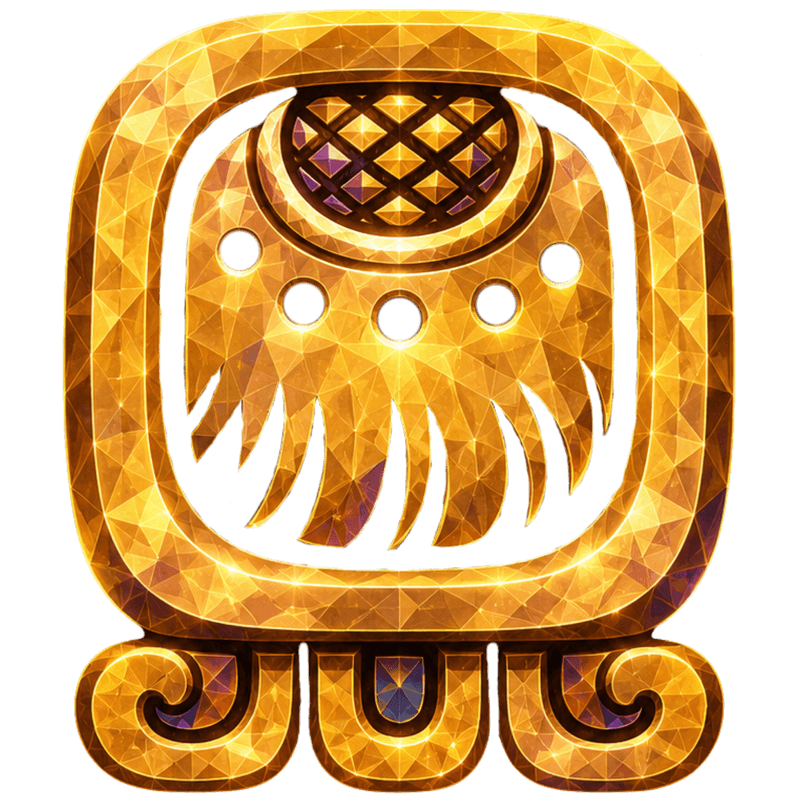
Your nawal waits in the calendar
Choose your birth date and press Reveal my Nawal to discover the energy that guides your day.
Get your complete birth-Nawal reading
Your complete birth-Nawal reading will be sent now. Recurring readings are optional. You can unsubscribe at any time.
Your woowoogle account is ready, check your email
Frequently asked questions
What is the Maya calendar based on?
The core sacred calendar is the 260 day Cholq'ij, built from 20 nawales and 13 numbers. It runs alongside the 365 day Haab solar calendar.
Is the Maya calendar the same as a 12 sign zodiac?
No. There is no 12 sign Mayan zodiac. The Cholq'ij combines 20 day signs with 13 numbers to form 260 unique days.
Did the Maya calendar end in 2012?
No. December 2012 marked the end of the 13th baktun in the separate Long Count. The Cholq'ij and Haab continued without a break.
When does the Maya day sign change for someone in Singapore?
Guatemala is 14 hours behind Singapore, so the day sign changes at midnight Guatemala time, which is 2pm the same day in Singapore.